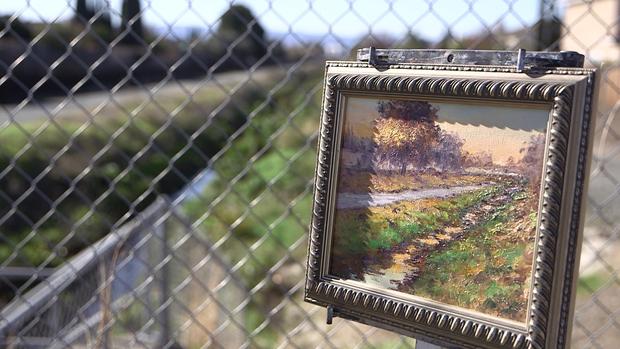
Yesterday I started the first in a series of how I learned to paint water. As I mentioned, what took me a week some forty years ago, I now do in an hour or two. Being primarily self-taught this is the second painting I did trying to learn to paint the multiple layers of water.
From the “quarentena de novo estúdio” I completed this around the same time of the work posted yesterday, around 1979. It was from a photo taken on a backpacking trip in the high Sierra. The deer weren’t there, but added them into the scene. Painting in oils, I first did the rocks, then let it dry, and kept glazing and adding layers. It took weeks between the drying and painting process. Now days I have learned how to paint wet into wet and everything can be done in one sitting.
This piece was also given to my parents which they hung in their home for many years, and now I think one of their grandchildren inherited it.
The photo might be a little blurry as it was scanned from a slide, and not sure what happened in the process.
Most artists can pinpoint certain works or events which led to a breakthrough painting, allowing them to reach a new plateau in their journey in creating art. In the next few posts, I’ll show a few works from the ‘way-back-machine’ on how I learned to paint water. I’ll tell the end of the story now…what used to take me a week to paint, I can now do in an hour or two. Due to the popularity of the book “Outliers”, they say it takes 10,000 hours to be truly “world class” at something. I am not sure about that, but learning to paint is a life long journey and endeavour!
From the “noua carantin? de studio” is a piece I did around 1978. The scene is a creek in the San Gabriel Mountains just above Pasadena, CA, probably the West Fork of the San Gabriel River. I took a photo of this scene during a hike and later painted it in my art studio (at the time also known as the living room) in Altadena, CA. The painting is a bit monochromatic, but I loved painting the clear water and rocks below.
As a post note, I later gave this piece to my parents which they hung in their home for many years, and now I think one of their grandchildren inherited it.
For the last 250 days I have posted on Facebook a painting each day as a brief diversion from the lockdowns and other bad news this year. Neglecting my weblog, I’ll post in the coming days some of my better posts. Here is one from a couple day’s ago….
I painted “South Fork” not long after moving to the San Francisco Bay area in 1979, and purchasing a small RV. I did frequent trips to the Sierra mountain range, to do plein air painting and just enjoy the environment. Back then it was just called outdoor painting or painting on location, but in more recent years has been dubbed the more exotic French term ‘en plein air’. This painting is of a creek close to Longbarn, CA off Hwy 108, where I spent a day or two at a forest service campground. It was painted in the studio from some Polaroid photos around early 1981.
Recently joining the Society of Western Artists, I entered this painting in one of their shows in Sacramento, CA. Much to my surprise, I was honored with a first place in the show.
Later that year, SWA award winners were displayed at the 35th Annual San Francisco Art Festival in the SF Civic Center Plaza. I remember this painting seemed so out of place with most all the other art pieces being abstract and modern works. Right next to my traditional piece was an almost 3 dimensional collage painting with among other things, a woman’s bra glued to it.
In May and June of 1982 it was part of a solo exhibition at the Carnegie Arts Center in Oxnard, CA. Most of this show were paintings from an extensive six month trip I had taken throughout the Southwestern US the prior winter. Later on, my father really liked the piece, so I gave it to him. He hung it in his office in Pasadena California for many years. For my old friends, this was GTA’s old office in the Hall of Administration, Ambassador College.
After retiring to Big Sandy, Texas, he hung it in his home for many years. Upon his passing six years ago, one of his grandkids inherited it, but not sure which one. (Perhaps whoever has it can speak up).
As I look at the piece now realize how far my works have improved over the years, and how far this painting has traveled. I later did a small 5×5 of the scene posted here on September 9.
Looking for a totally unique custom gift for the holiday season which will last a lifetime? These little paintings make great holiday gifts. Many times they are small versions of larger pieces I have done, and some maybe an experiment for a large piece. The Sunday after Thanksgiving will be celebrated as the first #ArtistsSunday. This is the biggest discount I ever sell my paintings, up to 70% off. Price is for unframed original, unless otherwise noted. Shipping is free in the continental US. If you are interested, just email me at donald@donaldneff.com. Click on the picture or the link below to see all the paintings, including pricing. #shopart
The quest started as a simple idea. I didn’t even know if I would, or even could finish it. After all, it was a commitment for a year. I didn’t know if it would turn out worthwhile, or just a stack of sticky panels for the scrap heap. I didn’t know if anything would be interesting or worth looking at.
I didn’t know I would eventually paint ghost towns in Silicon Valley, or haunted springs, or wild beaver sign in a metropolitan city, or the worlds largest homeless camp, or the world’s first ‘plein air selfie’.
I didn’t know eventually strangers would walk up to me, give me a hug, and say I brought back their fond childhood memories of days gone by in the “Valley of Hearts Delight’.
Little did I know it would grow with a feature on NBCTV, and other TV spots, articles by major publications, multiple showings in various venues, and a book.
Seven years ago today, I started a year-long quest to paint a different “Creek and River of Silicon Valley” each week en plein air, or on location. At the time, even finishing the year successfully was not known, but I ended up with 60 paintings of 43 different creeks all over the South San Francisco Bay area.
The collection of 60 paintings is still intact and will be for the foreseeable future. I am still seeking venues both local, national, and international for showings, so ideas are welcome!
One of the spectacular views in the world is Glacier Point in Yosemite National Park. The point offers a superb view of several of Yosemite National Park’s well-known landmarks, including Yosemite Valley, Yosemite Falls, Half Dome, Liberty Cap, Vernal Falls, Nevada Falls, Clouds Rest, and Yosemite’s high country. It is a must do if visiting Yosemite National Park. I just completed a new commission of the Glacier Point view, but maybe a little backstory first…
We started 2020 with a move to a new home in Marina, CA, not far from Monterey and Carmel. Due to last minute flooring problems with the new house, we had to change our plans and put all our stuff in storage and stay in temporary housing for almost a month. Well, we finally made it to the new place, and then the virus stuff hit!
The last painting I did at the old home was a commission piece and the subject of my last blog. Recently I posted a photo of that painting on Facebook, and another long time collector wanted one similar. So, the first painting I did in the new place is another commission piece of the same scene. Kind of like bookends to our move. I won’t make a duplicate of a prior painting but in order to be true, you can’t change the features of Half Dome, the falls, and other landmarks, but you can change the viewpoint, make it different in mood, skies, time of day, lighting, etc.
I don’t really have a studio set up yet as we are planning on building an outbuilding for the studio, so I set up in the garage. The contents of my old studio is still in boxes, some of which you can see in the first picture below.
Below are some pictures of development of the painting. This might look a little familiar as it seems a rerun of my last blog post!
I used my plein air easel in the garage to do the painting. Since the light is poor, I only could paint during the day under natural sunlight.
The block-in. I wanted to limit the foreground to give the viewer an idea of the over 3,000 foot drop off to the valley below.
I do another block-in starting to indicate the local color. Most of the sky is completed in one sitting so-as to keep itsoft, fluffy, and loose.
Continuing by painting the far mountains and Upper Yosemite Valley, including Liberty Cap. Also developing patterns of sunlight and shadow.
Starting to work on and define Half Dome
Further defining Half Dome and the bench it sits on.
Here is further definition of the shadows and lit areas. I am also working out how much of a foreground to put it.
Putting in the foreground. I am wanting to show the drop-off from 3200 feet to the valley floor.
More foreground definition.
The bottom left looks a little empty, and I need something to bring the eye back into the painting, so I keep adding trees to the drop-off.
The final painting is at the top of this weblog entry. I always seem to want to keep on working on a piece but then it starts to look overworked, but I think I stopped at the right level here.
Awhile back, a couple from the bay area, Van and Kathy, visited Yosemite and saw one of my paintings hanging in the Yosemite Renaissance show at the Yosemite Museum. The painting, titled “Misty Sentinel” can be seen here. They liked my work, so made an appointment to come by the studio and look at more paintings. They ended up purchasing 3 paintings, and mentioned they might want me to do a commission.
Van had hiked and camped all over parts of the Yosemite back country, from Tuolumne Meadows to Yosemite Valley, including a trek to the top of Half Dome. What he wanted was a morning view from Glacier Point, Yosemite as a reminder of his trekking.
Below is a diary of our journey together to create a painting. At each step of the way, I would email a photo to them so they could give their input as we progressed.
We started out by trading a number of photos to nail down the location, perspective and view he wanted.
I sent him this composite of several photos I took quite a few years ago of Glacier Point. You can see Nevada Falls in the middle right. Van wanted a view which showed both Vernal and Nevada Falls.
Van then sent this view closer to what he wanted, which showed both Vernal and Nevada Falls.
Van and Kathy cut out some cardboard to see what size painting they wanted, and put it up on the wall it will hang. We decided on a 22×28 canvas.
To get the view correct, I first did a pencil sketch and emailed it to them. He wanted to show a little bit more of the cliffs on the left and right, so I erased that part, and redrew just the sides resulting in this sketch. Since I had to push in from the sides, the scene is not exactly correct to perspective. I also wanted to bring forward the falls on the right, so made them a little more pronounced than what you might see in real life.
We were in the process of selling our home so my studio was crammed full of storage boxes and no room to paint.
So, I set my portable easel on the side of the house by the trash cans to do a small color study.
Van was very discerning on what he wanted, which was a view at around 10:00am, so I did a rough color sketch to see if I got the right mood and general colors correct.
The next step was to transfer the sketch to the full size canvas. I usually do this freehand, and don’t use grid marks, but in this case used a grid to ensure all elements, especially Half Dome were in perspective according to the approved original pencil sketch.
In the meantime, our house sold and we didn’t have to keep it quite so ‘staged’ for potential buyers. It was the start of the rainy season, so our solarium sun room became a temporary studio.
Next is a color block-in with one color, a purplish hue from a mixture of Ultramarine Blue and Quinacridone Red. The underlying purple will give the entire painting a warm undertone.
My palette consisted of the following: Cobalt Blue, Thalo Blue (just for pure sky), Ultramarine Blue, Quinacridone Red, Cadmium Red Deep, Sap Green, Transparent Red Iron Oxide, Yellow Ochre, Cadmium Orange, Hanson Yellow Light, Quick Dry White.
The next step is a continuation of the block-in putting in a little more neutral grays and refining the drawing. The gray is a varying mixture of Cobalt/Cad Red Deep.
Van wanted lenticular clouds, so those were sketched in.
I now start to refine from the sky down to the distant mountains, and start putting more color in the valley to the right.
Detail of the ‘Little Yosemite Valley” area at this stage.
I now turn my attention to Half Dome, the star of the show, and start to detail it continuing to use the Cobalt/Cad Red gray and the purple mixed with various amounts of white to detail the cliff. I also begin to add Yellow Ochre, and Hansen Yellow Light for the trees both in sunlight and shadow. Also, Van wanted more lenticular clouds over the distant peak, so put those in. I also start placing some morning fog and other wisps of clouds here and there.
The foreground is next, where I place the trees, and continue to work all over the canvas adjusting accordingly.
Continuing the foreground and adjusting.
Several times during this stage, I let it dry, and then put a coat of Liquin over the background mountains to isolate the layer and thinly paint in more atmosphere in the distance.
Detailing the foreground and adjusting.
At this stage, I made an appointment with the the collectors to deliver the painting, and for the next several days made minor adjustments prior to delivery.
The night before delivery of the finished piece, something still bugged me about it, and my wife suggested more green and brighten up the foreground. I also didn’t like the straight line. on Half Dome’s shoulder, so broke that up to make it more like a ragged cliff. This was done the morning before the delivery, so it was still a little wet.
Here is the piece as I delivered it to the collectors. Please note throughout this diary, the painting was photographed in various lighting, and although I tried to correct it in Photoshop, sometimes it just was a little different.
Upon arrival at the collectors home, Van asked for a few changes, as it is really hard to judge a painting by online photos.
I touched up the sky a bit, and also downplayed the foreground taking out some of the highlights so the eye would tend to go to the distant peaks and valleys.
Here is another picture of the piece in their home. Since it wasn’t framed yet, we propped it up on a few open drawers
Doing commissions can sometimes be a hit and miss, trial and error process until both the artist and collector are satisfied. When the collectors first saw the piece in real life, they said it did not look quite like the pictures I had been texting and emailing online, even though I tried to send as accurate photo of the painting I could. After touching it up a bit at delivery time, though, it seemed they were pleased, at least I hope so!!
The Open Space Authority of Santa Clara Valley recently published an article featuring my year long quest to paint and Preserve Coyote Valley. I didn’t know about several other like minded artists also featured, and we certainly need to get together!
Having spent my adolescent and twenties in East Texas, I am always enchanted by the beautiful skies and clouds when I go back to visit. Huge thunderheads, magnificent in their awesome power would bring refreshing, but short bursts of moisture during the summer months. Huge puffy cumulus clouds would fill the sky rolling slowly past in no hurry to get anywhere.
In my younger days working outside in the the hot summer sun, the cloudbursts would bring a short refreshing cool break to the heat, but in an hour or two there would be no evidence of the downpour.
Here in the San Francisco Bay area, we rarely see such wonder in the skies. Being close to the Pacific, the skies are usually a non-event. The exception is just after a winter storm.
A bit of unusual weather for this time of year, we had our first rain of the season, and the skies were wonderful with puffy cumulus clouds and rain squalls passing through, and I always take notice. Generally we don’t get this type of weather until our somewhat mild winter season.
In the foreground, Coyote Canal zigzags around the hills. Built in 1936, this canal originally carried water from Anderson Lake to fill percolation ponds and irrigation ditches around Santa Clara Valley. Water was deliberately routed around Coyote Valley to keep groundwater levels there from becoming too high. Today, the Coyote Canal delivers water only a short way to where it is then channeled through underground pipes.
Soon, if this rain keeps up, the golden grass of the California coastal hills will turn emerald green towards the end of year…and I will have to adjust my artist’s palette!
The Malaguerra Winery was set on the eastern edge of Coyote Valley and the foothills of the Diablo Range. Erected in 1869 for Swiss immigrant Jose Maria Malaguerra, it is the oldest extant winery structure in Santa Clara County. Constructed of stones hauled from nearby Coyote Creek, it was completely stuccoed, but much of the stucco is now falling off revealing the original stones.
Cultivation of grapes on a commercial basis began in this area during the early 1850s, and by 1860 Malaguerra was one of twenty-six vintners in the county. A national depression during the mid-1890s and over-production of grapes resulted in many local wineries closing. Among these was the Malaguerra Wine operation which stopped in 1898. The winery was revived and expanded at the turn of the century, and remained in operation until 1950.
When he was 48 years old, Jose Maria Malaguerra married 20 year old Alvina and they built a house in the flat area near the winery building. Over the next 20 years, Alvina gave birth to twelve children. After Jose died in 1902 from bronchitis, Alvina moved off the land, settling in Palo Alto with various daughters. She was 90 years old when she died.
On the National Register of Historic Places, at one time, it was reportedly being renovated into a museum, but I saw little signs of that now.
Painting number five in my Preserve Coyote Valley Quest is a studio painting of what’s left of the old Malaguerra Winery. Having quite a bit of very hot days recently, I wasn’t in the mood to paint en plein air. I painted this using photo studies from visiting the site.